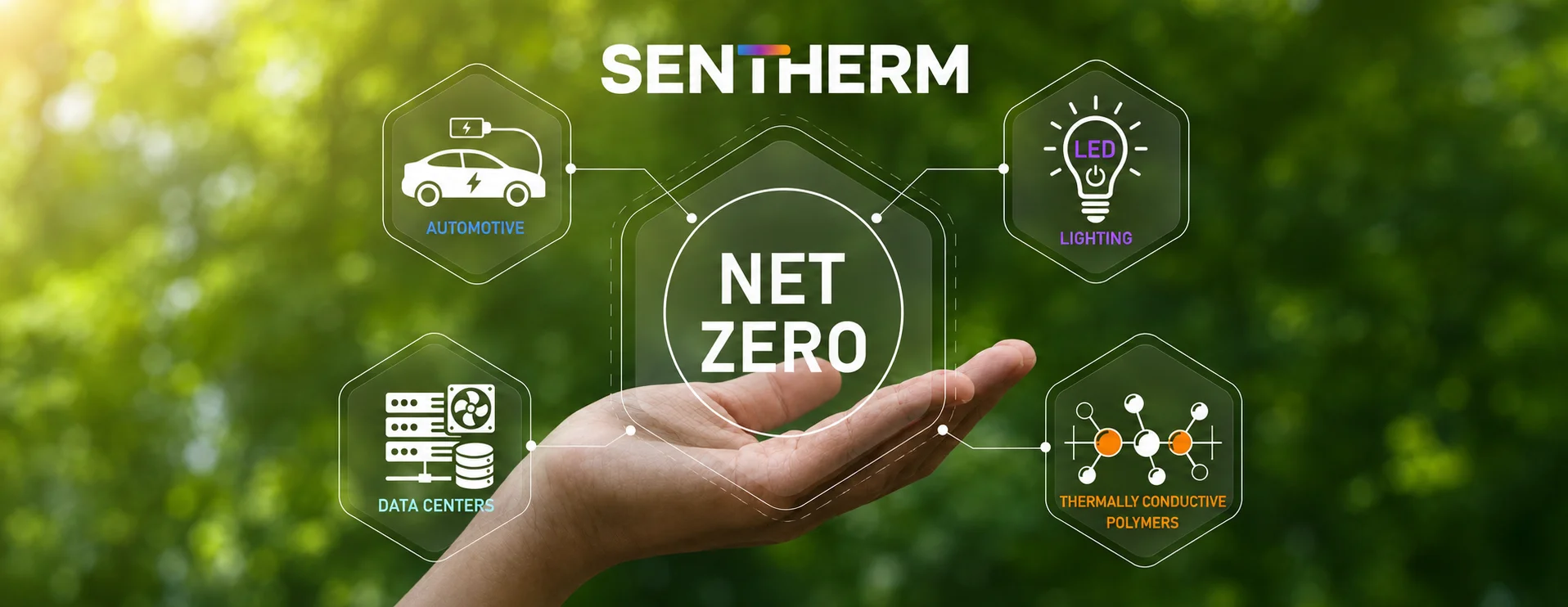
Redefining Thermal Efficiency: How Thermally Conductive Polymers are Reshaping Data Centers, Lighting, and Automotive Systems.
As industries race toward Net Zero carbon targets, a quiet revolution is happening at the molecular level. For decades, aluminium and copper have been the undisputed kings of thermal management. However, traditional metals carry high financial costs, significant weight, design limitations, and massive embodied carbon footprints.
Leveraging advanced material science, Senergy Innovations’ SenTherm thermally conductive polymer solutions are now matching aluminium’s thermal performance while unlocking design flexibility and sustainability metrics previously thought impossible.
Originally born out of next-generation solar thermal technology, the SenTherm resin family (including advanced formulations using PA6 and PPA) is stepping into the spotlight. It is solving critical heat challenges across three massive commercial sectors: Data Centers, High-Performance Lighting Systems, and Automotive Systems and Components.
1. Data Centers: The Next Frontier of Advanced Thermal Management
Data centres are the backbone of our digital and AI-driven economy, but their power and cooling demands are skyrocketing. Traditional air-based cooling is reaching its physical limits, forcing a massive industry shift toward direct-to-chip, rear-door heat exchangers, and liquid cooling architectures.
SenTherm provides a direct answer to these high-density cooling challenges:
• Corrosion-Resistant Heat Exchangers: Unlike metals that degrade or corrode when continuously exposed to complex cooling fluids, SenTherm polymers are entirely non-corrosive. This ensures decades of operational reliability.
• Lightweight Cooling Sheets: The material can be compression-moulded into ultrathin, intricate cooling sheets and heat sinks. This reduces the weight load on structural server racks while maintaining exceptional heat transfer rates.
• Lower Embodied Carbon: By replacing energy-intensive aluminium with unreinforced, toughened polyamides, facility operators can significantly slash the scope 3 emissions associated with building and upgrading data infrastructure.
2. Next-Gen Commercial Lighting Systems
The lighting industry's evolution didn’t stop at LEDs. While modern LEDs are highly efficient, they generate massive, localised heat at the diode level. If that heat isn't dissipated rapidly, the lifespan and lumen output of the fixture drop dramatically.
Influenced by our presence in automotive, SenTherm transforms commercial lighting design:
• Complex Geometry Injection Moulding: Traditional aluminium heat sinks are restricted by machining and extrusion limits. SenTherm resins are engineered for highprecision injection moulding, allowing designers to integrate complex heat-dissipating fins directly into the aesthetic body of the light fixture.
• Electrical Isolation: Formulations like SenTherm 301-01 2 offer a dual advantage: they are highly thermally conductive yet electrically isolating. This eliminates the need for extra insulation barriers between the circuitry and the heat sink, shortening assembly times and reducing overall component size.
3 Automotive Systems
Sentherm are establishing a notable presence in automotive applications, expanding from battery systems to whole vehicle heat management, including lighting systems, power electronics and auxiliary thermal systems. Sentherm’s TCPs enable considerable lightweighting of systems; an area that is crucial with increasing weights of battery and hybrid vehicles. Their ability to be injection moulded into complex geometries also creates opportunities for multi-functional heat-spreading structures and components, supporting improved thermal performance of the entire system, while reducing weight.
In addition to this, the ability to injection mould electrically isolating products can drastically reduce assembly time and complexity, thus reducing overall costs with greater design freedom across the vehicle.
The Big Picture: Material Science Meets Sustainability
True industrial innovation requires a departure from legacy material choices. By matching the thermal performance of metals while offering superior design freedom, lower weight, and a drastically reduced carbon footprint, Senergy Innovations' SenTherm proves that the future of engineering isn't just smarter—it’s lighter, cleaner, and built on advanced polymers.
Are you looking to optimise your hardware’s thermal management or reduce the embodied carbon of your next project?
Let’s open the discussion:
• Which thermal management bottlenecks are currently slowing down your product designs?
• How is your organization tackling the scope 3 emissions of infrastructure hardware?